If you're a small or mid-sized business owner, the question of whether to offer a 401(k) plan comes up eventually. Maybe a candidate brought it up during an interview. Maybe a long-time employee asked. Maybe you're trying to figure out how to compete with larger companies for talent.
The short answer: a 401(k) is one of the most cost-effective, high-impact benefits you can offer. It helps you attract better candidates, keep the people you already have, and reduce your own tax burden.
This helpful blog covers the main benefits of offering a 401(k), what it actually costs employers, and what to think about when you're deciding whether it's the right move for your business.
Why employees care about retirement benefits (more than you might expect)
Wages get a lot of attention during hiring negotiations, but retirement benefits often carry more weight in a candidate's long-term decision. Someone evaluating two similar job offers isn't just comparing take-home pay, they're looking at the full picture.
A 401(k) with an employer match signals something beyond compensation. It tells candidates and current employees that you're thinking about their financial future, not just this month's paycheck. That matters, especially as more of the workforce moves toward companies that treat employees as long-term partners rather than interchangeable resources.
For employees who are actively saving for retirement, the difference between a job with a 401(k) and one without can represent tens of thousands of dollars in long-term wealth. That gap is hard to ignore when someone is making a career decision.
The Employer Benefits Of Offering a 401(k)
1. Attract better candidates
The talent market is competitive across nearly every industry. Smaller businesses often assume they can't keep pace with the benefit packages that larger companies offer, but a well-structured 401(k) plan levels the playing field more than most employers realize.
When candidates compare total compensation (not just salary) a 401(k) plan with an employer match can make your offer stand out. Many job seekers, particularly experienced professionals in their 30s and 40s, factor retirement benefits heavily into their decision. Leaving a 401(k) match on the table is real money, and candidates know it.
If your competitors in the same industry or region are offering retirement benefits and you're not, you're starting every hiring conversation at a disadvantage.
2. Retain employees longer
Turnover is expensive. Recruiting, onboarding, and training a replacement employee often costs more than most business owners budget for. Retention benefits like a 401(k) give employees a concrete financial reason to stay.
The long-term effect of reduced turnover (lower recruiting costs, more experienced teams, better customer relationships) compounds over time and often far exceeds the cost of the employer match itself.
3. Tax advantages for your business
One of the most underappreciated parts of offering a 401(k) is what it does for your tax bill. Employer contributions to a 401(k) plan are tax-deductible as a business expense. If your business contributes $500 per employee per year in matching contributions, that entire amount reduces your taxable income. Depending on your business structure and tax bracket, the after-tax cost of your contributions can be meaningfully lower than the face value.
There are also startup tax credits available to eligible small businesses. The SECURE 2.0 Act, signed into law in 2022, expanded credits that can cover a significant portion of the costs to set up and administer a new 401(k) plan. This includes up to $5,000 per year in plan startup costs for the first 3 years, plus an additional credit tied to employer contributions for businesses with 50 or fewer employees.
If you haven't spoken with your CPA about these credits in the context of starting a plan, it's worth the conversation. The out-of-pocket cost of offering a 401(k) may be lower than you think.
4. Tax benefits for employees
When you offer a 401(k), employees can contribute pre-tax dollars (for traditional 401(k)) or after-tax dollars (for Roth 401(k), if your plan allows it). Pre-tax contributions reduce an employee's taxable income for the year, which means the retirement contribution goes further than a simple dollar-for-dollar comparison to a raise would suggest. For employees in meaningful tax brackets, this is a real financial advantage.
5. Strengthen your company culture and employee trust
Benefits communicate values. When a business offers a retirement plan, it sends a message: we're planning to be around for a while, and we're investing in you for the long haul.
That kind of signal matters to employee morale in ways that are hard to quantify but easy to observe. Teams that feel valued tend to be more engaged, more productive, and more willing to go beyond the minimum. Employees who feel financially supported bring a different energy to their work than those who feel like a number on a payroll report.
For small businesses in particular, where culture is often one of the primary competitive advantages, this effect can be significant.
6. Owner and key employee retirement savings
If you're a business owner, don't overlook the personal benefit. Offering a 401(k) means you can participate in the plan as well. Depending on the plan structure, this can allow you to shelter a significant amount of income from taxes each year while building your own retirement savings.
Contribution limits for 401(k) plans are substantially higher than IRA limits. In 2025, employees can contribute up to $23,500, with a catch-up contribution of an additional $7,500 for those 50 and older. When combined with profit-sharing features in a plan like a Solo 401(k) or a safe harbor plan, business owners can often shelter even more.
If you're at a point in your business where taxes are a growing concern, and you haven't maximized your retirement savings options, this is one of the most straightforward tools available.
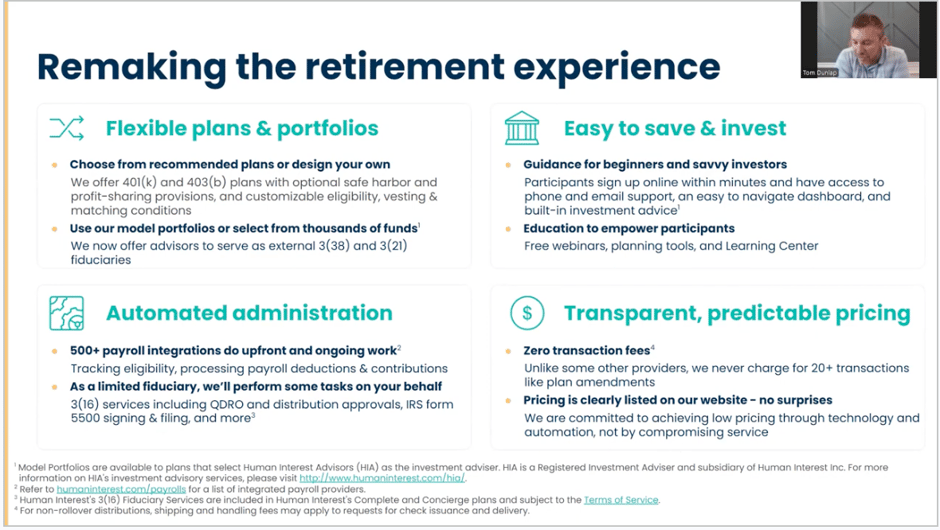
What does a 401(k) actually cost employers?
We recently talked about the actual employer cost of a 401(k) plan on our recent webinar with our 401(k) partner, Human Interest. Check out that video above for a more detailed explanation, but the short answer is, its much less expensive than you would expect, even when you factor in the employer match costs.
Common match structures include:
Dollar-for-dollar match up to a percentage of salary (e.g., match 100% of the first 3% of employee contributions)
Partial match (e.g., match 50% of the first 6% of employee contributions). For many small businesses, a modest match (even 25 to 50 cents on the dollar up to 3 or 4% of salary) is enough to make a plan competitive and meaningful to employees, while keeping employer costs predictable.
Small Businesses May Qualify for 401(k) Startup Tax Credits
Many small businesses assume a 401(k) is too expensive or too complicated to set up. That may have been a bigger barrier in the past, but current tax incentives can help reduce the cost. The IRS states that eligible employers may be able to claim a tax credit of up to $5,000 per year for three years for ordinary and necessary costs of starting a qualified plan, including a 401(k). That credit can help offset expenses such as plan setup, administration, and employee education.
This is one of the most important reasons small businesses should revisit the idea of offering a retirement plan. The upfront cost may be lower than expected, especially when paired with the right provider and proper payroll integration.
How Horizon Payroll Can Help
Setting up and administering a retirement plan is easier when your payroll and benefits systems work together. At Horizon Payroll, we can help employers build benefit packages that fit their business and budget, including support for benefits integration that keeps retirement contributions accurate and on schedule without adding to your workload.
If you're exploring whether a 401(k) makes sense for your business, or you're trying to figure out how to structure a plan that helps with retention without creating compliance headaches, we can help you think through the options.
Offering a 401(k) is a major step for your business, but it should not make payroll harder than it needs to be. Horizon Payroll helps businesses manage the payroll side of employee benefits with accuracy, consistency, and practical support. From payroll deductions to contribution tracking, our team and our partners at Human Interest can help you keep payroll aligned with your retirement plan requirements.
Ready to Strengthen Your Employee Benefits?
A 401(k) can help your business attract talent, retain employees, support financial wellness, and provide valuable tax advantages. It is more than a retirement plan. It is a long-term investment in your people and your company. Contact Horizon Payroll Solutions to talk through your benefits and payroll needs. We're based in Miamisburg, OH, and work with businesses across 40 states, from single-employee shops to companies with 1,000 or more on payroll.
This post is for general informational purposes and does not constitute tax or legal advice. Consult with a qualified tax advisor or attorney before making decisions about your retirement plan.


 Payroll Management
 HR Support
 Time & Attendance
 Benefits
 Hiring & Onboarding
 Solution Add Ons
 Horizon Payroll Solutions

 Horizon Payroll Solutions : April 6, 2026 at 10:00 AM